Editorial note
In Act 1, Scene 1 of King Lear, Lear addresses Cordelia, his youngest and most cherished daughter, and Kent, one of the King's servants, and responds to how Cordelia has "betrayed" him by refusing to declare her love for him publicly. Lear had planned to divide the kingdom into three sections, each gifted to one of his daughters as a reward for their declarations of love. Goneril and Regan, his other daughters fulfill his wish and offer him King Lear numerous compliments, thus appeasing his ego. Cordelia, however, simply states that she loves him as she is expected to, but does not boost his ego by showering him in praise. Lear therefore enters a fit of rage and tells Kent that he will disown Cordelia, and even evokes the names of the gods, showing the seriousness of his sentiment. Cordelia must then fend for herself, and is left at the hands of two royals who wish to gain her hand in marriage: the King of France, and the Duke of Burgundy. Lear declares that he does not wish to be involved in her engagement and life, leaving them to decide who marries her.
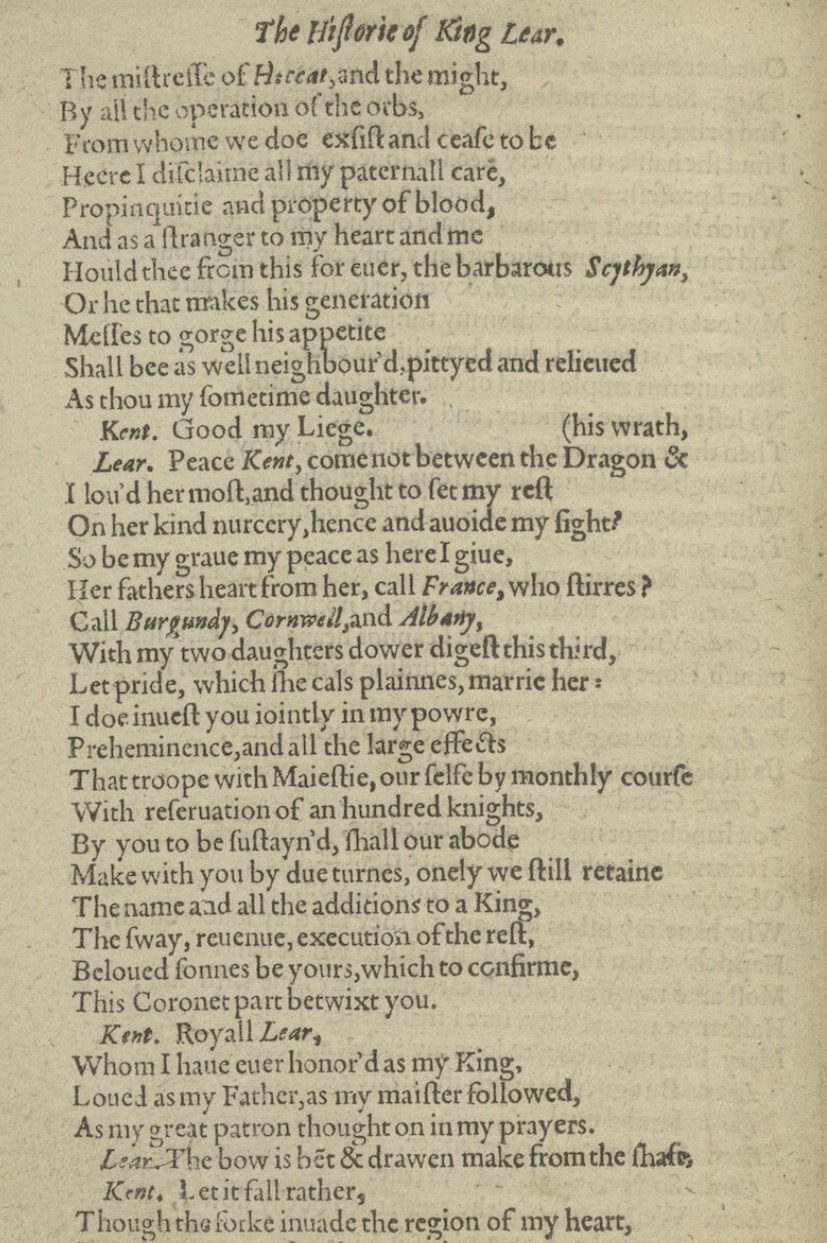
The First Quarto edition, B2v, capitalizes on Lear's anger and need for power, as he deems Cordelia's failure to profess her admiration a reason for her to be excommunicated from her inheritance. The scene primarily focuses on Lear and Kent’s reactions and feelings, and pays no regard to Cordelia’s perspective or feelings whatsoever. Throughout the entire passage, there is an underlying tone of misogyny, which is revealed through the capitalization of certain words associated with masculinity (Dragon, when Lear refers to his power as king, and Liege), and through the fact that Cordelia is overshadowed by the other characters, as although it is her future that is being decided, she is disregarded. Lear's narcissism and thirst for power outweighs Cordelia's fate. During this time period, being bereft of the help and support of her family would be extremely detrimental, and Lear is aware of this, however the wounding of his ego is deemed more important than his own daughter.
When editing this page, we chose to change the wording to make the scene more inclusive and attune to Cordelia, as well as to the modern audience. By amending the wording and capitalization of the First Quarto, we hope to make the scene less male-centric, though it is told from Lear's point of view. Female characters are often both overlooked and overshadowed in early-modern literature, so by changing the diction throughout, we hope to provide a more accurate representation of female characters written during the Shakespearean era of literature.
The mysteries of the Hecate and the night,
By all the operation of the orbs,
From whom we do exist and cease to be,
Here I disclaim all my parental care,
Propinquity and property of blood,
And as a stranger to my heart and me
Hold thee from this forever, the barbarous Scythyan,
Or he that makes his generation
To gorge his appetite
Shall be as well neighbored, pitied, and relieved
As thou my sometime Daughter
Kent. Good my Leige.
Lear. Peace Kent, come not between the Dragon and his Wrath
I loved her most and thought to set my rest
On her kind nursery, [To Cordelia] Hence and void my sight!
So be my grace my peace as here I give,
Her fathers heart for her, call France. Who stirs?
[To an Attendant] Call Burgundy, Cornwall, and Albany
[To the princes] With my two daughters’ dower digest the third,
Let pride, which she calls plainness, marry her.
I do invest you jointly in my power,
Preeminence, and all the large effects
That troop with majesty, our self by monthly course
With reservation of a hundred knights,
By you to be sustained, shall our abode
Make with you by due turn, only we still retain
The name and all the additions to a King,
The sway, revenue, execution of the rest,
Beloved children be yours, which to confirm,
This coronet part between you.
Kent. Royal Lear,
Whom I have ever honored as my King,
Loved as my Father, as my master followed,
As my great patron thought on in my prayers.
Lear. The bow is bet and drawn. Make from the shaft.
Kent. Let it fall rather,
Though the fork invade the region of my heart,
Image credit: Rare Book Division, The New York Public Library Digital Collections, copy *KC 1608. His True Chronicle Historie of the life and death of King Lear and his three Daughters. First Quarto. London: 1608.
Citing this page: Shakespeare, William. King Lear, B2v. London: 1608. Cacodemon Digital Shakespeare. Edited by Elena Cumello and Sofia Nesta. Source edition: Rare Book Division, The New York Public Library (*KC 1608). http://cacodemonshakespeare.com/tragedies/lear/b2v.
