Skip to content

Hamlet, B3r

Editorial note

The text presented provides a deeper understanding of Hamlet through close textual analysis. The translation is kept closely intact from the original as the message of the passage is conveyed through interpretation. The translation highlights the words representing night, day, passage of time, loyalty, and supernatural themes. In this particular scene the descriptions of night and day serve as a dichotomy reflecting how the night harbors secrecy as well as the supernatural, and the transition to day contemplates clarity and safety. These themes can also be associated with death and life. As time passes it serves as a transition or a purgatory which fades the supernatural. Additionally, in this scene Horatio and Marcellus loyalty towards Hamlet is tested as duties are often seen as a performance throughout the play rather than genuine loyalty. 


These themes are the main focus of this page and our interpretation allows the audience to freely ponder the profound meaning of Hamlet as a whole. It creates a space for first time readers to understand a deeper and more nuanced interpretation of Hamlet. There are complexities to unravel, but this editorial serves as a beginners first look into the textual meanings of this play This scene opens with descriptive imagery of the transition from night to day, and then focuses on a conversation between Horatio, Marcellus, and Hamlet. To make the text more modern the medial “s” was changed into the modern “s.” Additionally “u” and “v” were replaced when necessary to ensure modernization. 

The bird of dawning singeth all night long, 1

And then they fay, no spirite dare walke abroad 2,

The nights are wholesome, then no planet srikes,

No Fairie takes, nor Witch 3hath powre to charme,

So gratious, and so hallowed is that time.4

 Hor. So haue I heard, and doe in parte believe it:

But see the Sunne in russet5 mantle clad,

Walkes ore the deaw of yon hie mountaine top, 

Breake we our watch up, and by my aduise,

 Let vs impart what wee have seene to night 

Unto yong Hamlet: for upon my life 

This Spirite dumbe to vs will speake to him:

Do you consent, wee shall acquaint him withit,

As needefull in our love, fitting our duetie6?

Marc. Lets doo't I pray, and I this morning7 know,

Where we shall finde him most conveniently.

Enter King, Queene, Hamlet, Leartes, Corambis and the two Ambassadors, with Attendants, 


King Lordes, we here have writ to Fortenbrasse

Nephew to olde Norway, who impudent 

And bed-rid, scarcely heares of this his

Nephews purpose: and Wee heere dispatch

Yong good Cornelia, and you Voltemar aid

For bearers of these greetings to olde 

Norway, giving to you no-further personall powers

To business with the King,

Then those related articles do shews.

Farewell,and Iet your haste commend your duties8.

 Gent. In this and all things will wee thew our dutie....

 King Wee doubt nothing hartily farewel:

And now Leartes, what's the news with you 

You said you had a fute what i’st Leartes?

Lea. My gratious Lord, your favorable licence,

Now that the funerall rites are all performed,
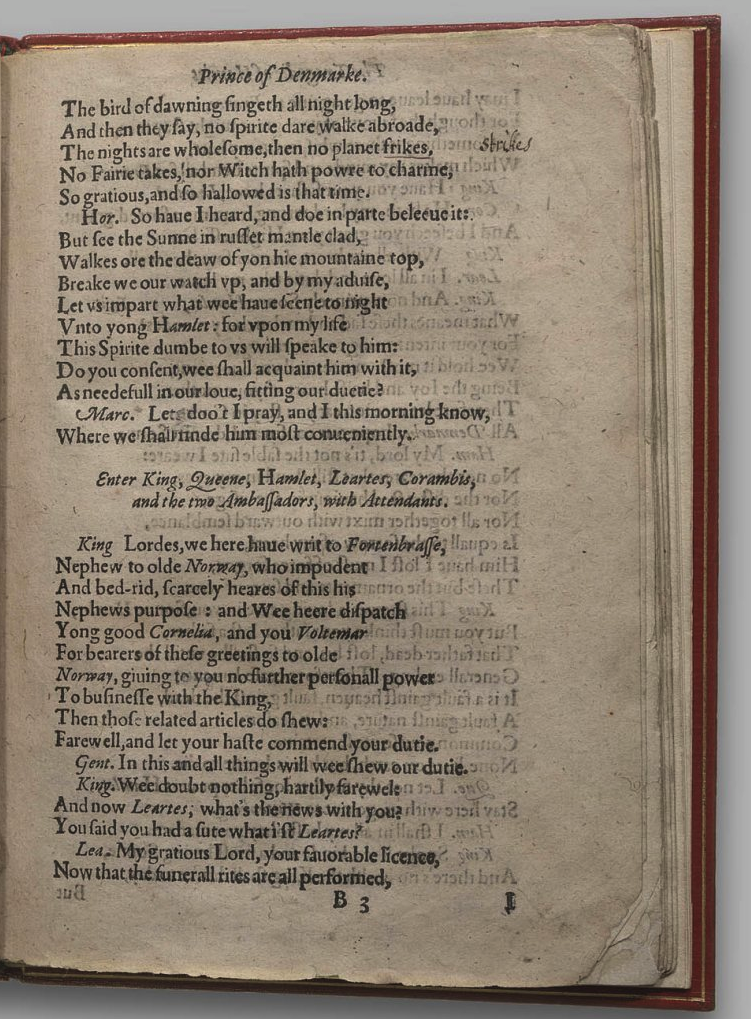
Image credit: British Library (Halliwell-Phillips edition). The tragicall historie of Hamlet Prince of Denmarke. First Quarto. London: 1603.

Citing this page: Shakespeare, William. Hamlet, B3r. London: 1603. Cacodemon Digital Shakespeare. Edited by: [your names]. Source Edition: British Library (Halliwell-Phillips Edition). http://cacodemonshakespeare.com/tragedies/hamlet/b3r.

☜

☞

Notes

  1. This line refers to a rooster which is represented as “The bird of dawning.” Roosters are known in many cultures for warding off evil and spirits which adds on to the notion that the day erases the evil of night.
  2. Spirits and ghosts were often not believed to be able to survive in the daylight, which furthers the general trend of daylight revealing the truth and casting light on deceptive actions. It also simultaneously banishes any untoward ideals like lies and, in this case, the manifestation of the ghost of King Hamlet
  3. The supernatural occurs in the “night” and as the sun rises the spirits and witches and other supernatural lose their power. This also follows the themes of secrecy and deception in Hamlet.
  4. The morning is seen as safety and the time where the supernatural disappears and the light prevails over the dark and the secrets it harbors. This also highlights that it is hard to decipher from what is real and what is fantasy in the play
  5.  Russet is a color that is reddish-brown which is the description of blood. This representation of the transition from night to day projects bloodshed which is soon to dawn on the Kingdom of Denmark from the secrets hiding in the dark coming to truth in the day.
  6. This line highlights the respect that Marcellus and Horatio have for Hamlet. It also suggests that their loyalty is genuine. However, they still express hesitation when mentioning the ghost to Hamlet. The question regarding “needefull in our loue” is complicated as it questions whether or not Marcellus's and Horatios love is genuine out of obligation or love itself.
  7. In a state of transition, dawn, which can equate to the hidden truths that are in play within their relationship to Hamlet. The interplay between night and day can also apply to the larger themes found throughout Hamlet, such as the state of Denmark and how it begins to unravel under Claudius’s reign versus King Hamlet’s. It also follows how the thin line between life and death are related in more than just the passage of time as the ghost of King Hamlet can only appear at night.
  8. Loyalty is also associated with the novel's theme to perform. Loyalty can also often be confused for deception in this play as characters tend to be untrustworthy and often having to perform their loyal duties. This is exemplified by Claudius performing as a King, Gertrude performing as a Queen, and Marcellus and Horatio also perform their loyalty to Hamlet as his subordinates. Just like the dichotomy between night and day, loyalty has a double meaning correlated to performing
css.php