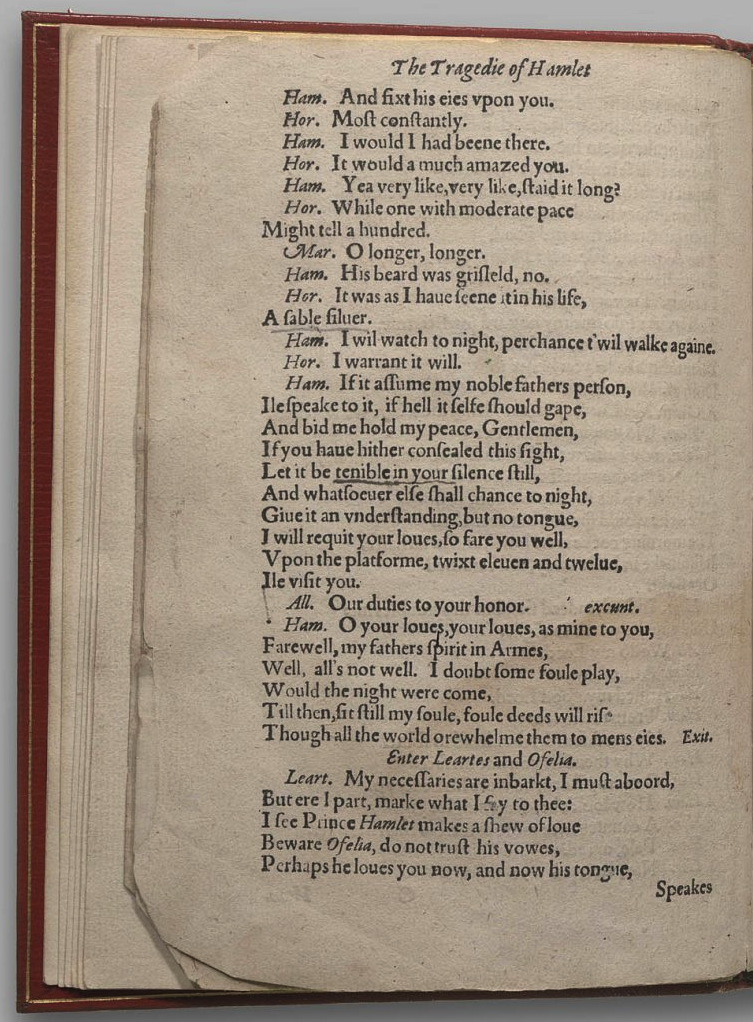
- It is established that Horatio is an educated, worldly man. Thus, his implied amazement or shock carries more weight that that of, for example, Marcellus, whose past is unknown but has presumably spent much of his life as a knight of Elsinore. Doubly, this line emphasizes the kinship between Horatio and Hamlet because it suggests that he knows Hamlet's mind intimately. Though he may not be as rich or politically powerful as Laertes, his favor in the eyes of Hamlet lends him influence all the same.
- The repetition of "very like" shows the shock that Hamlet feels receiving the news of his father's apparition. A assertion of great magnitude will need great evidence.
- Horatio's admittance to knowing the king's likeness is significant in itself; having known the king well enough to identify his appearance indicates a certain status of person.
- The choice of "sable silver" instead of gray/white to describe the color of the king's bread is a combination of the imagery of "sable" a small mammal which is often used for its fur, and "silver" a precious metal. Both associated with the fashions of the wealthy.
- The only account Hamlet trusts is his own. Taking into account our interpretive ending to the scene, this line not only hints at Hamlet's distrust of his peers, even those closest to him, but also at the insecurities he holds within himself regarding his position of power.
- Hamlet is wary of their allegiances and entertains the possibility that they have already informed others about the ghost.
- The word "tenable" refers to an ability to hold and defend from attack. Given Elsinore's isolated and fortified nature, the invocation of this word only heightens the tension that Hamlet feels surrounding his secrets. The implication here is that there is attack to be had, and Hamlet is constantly playing defense again those who surround him.
- In the source text, Hamlet alone stays onstage to perform a short soliloquy. After he exits, Laertes and Ophelia enter. This editorial version creates literal conversation through the two mens' speech, and eliminates the feel of a scene break that is present in the source text.
- This line was originally spoken to Ophelia, so this editorial addition of the stage direction thus deflects the dialogue back onto Hamlet.
- In this context, "I doubt some foul play" takes a sardonic tone. Instead of referring to his father, it mocks Laertes' severity in the previous line, and thus attempts (unsuccessfully) to deflect Laertes' misgivings about his character.
- Calling attention to Hamlet's title shows why Laertes is suspicious of his affections, Hamlet outranks them and therefore has license to be careless with his courtships. It also calls attention to the stagnancy of Hamlet's position; where he by rights should have been king, he remains a prince. This subtle indication of Hamlet's powerlessness over his own situations contributes to Laertes' later statement that Hamlet would never be able to marry Ophelia even if wanted to.
- A "show" is entertaining but fiction nonetheless, and therefore Laertes' disapproval and distrust of Hamlet's affection is epitomized by this line. It also calls into question his respect for Hamlet's title, as mocking/criticizing the Crown Prince of Denmark is a crime he commits freely.
- Changed from the original "Till then" to preserve meter without disrupting the conversation between Hamlet and Laertes as we have presented it here.
- Even the word "perhaps" conveys the uncertainty surrounding Hamlet's actions, and his suspected but unconfirmed duplicity.
- The word is changed from the original "tongue" to "eyes" to create stronger connection between Hamlet and Laertes' rhyming couplets at the end of the scene. "Men's eyes" thus relate to Hamlet's sight, and one interpretation can then be that the "foul deeds" rising to Hamlet's eyes are coming from within him.
- This final line marks the most drastic change to this edition. The final line of the section creates a rhyming couplet to match the one that Hamlet speaks a few lines before. Using the word "eyes," as Hamlet does in his couplet, Laertes' words turn Hamlet's distrust back on himself, the final line gesturing with finality at the the prince's inner turmoil and insecurity.
