Editorial note
Performing Shakespere is challenging, actors have to understand the plot, interpret their character’s emotions through the character’s actions, and perform their lines with the proper rhythm, all while memorizing lines in early modern english. This Edition aims to edit the play for performance by actors who are inexperienced with Shakespere by simplifying the the syntax and vocabulary to allow actors to focus on character performance and rhythm.
All long s characters, i/j and u/v shifts have been removed, abreviations of characters names were expanded, and the italics on the proper nouns were removed.The indentations were maintained because they provide clear distinctions between character’s lines. Words with updated spellings are highlighted in blue. The written annotation on the page was added into the play as a stage direction. Because physical stage directions can give further insight into the characters emotion. This is not a completely modernized version of the play so actors can gain a little familiarity with the language for when they perform a proper early modern english version of the play.
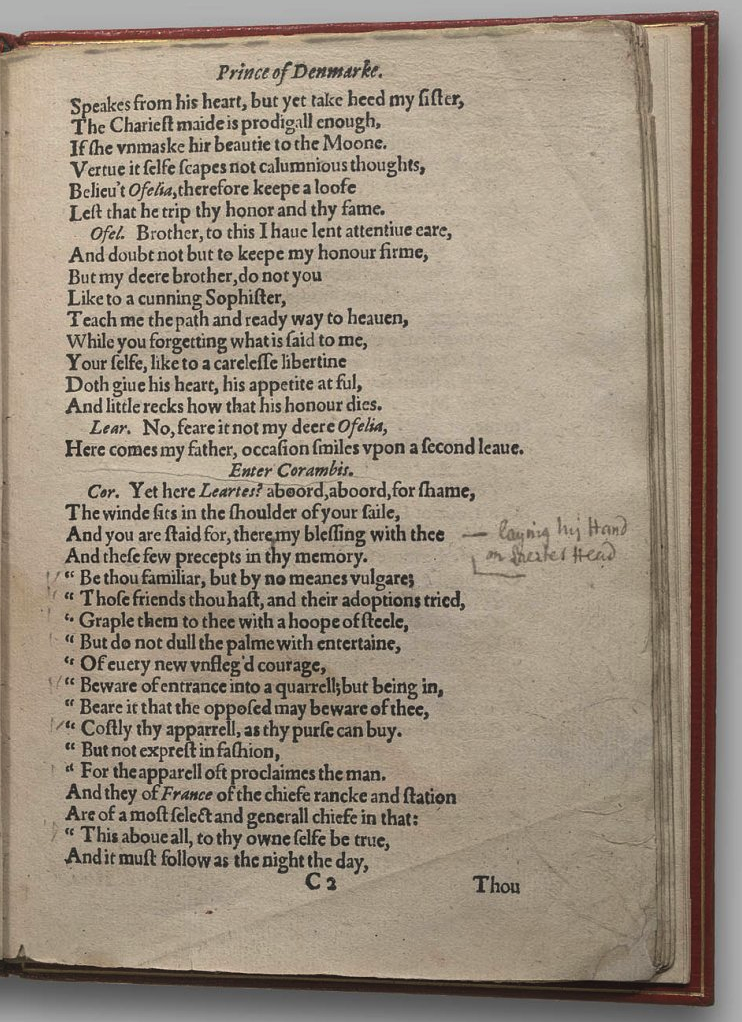
Prince of Denmark.
Speaks from his heart, but yet take heed my sister,
The modest1 maid is reckless2 enough,
If she unmask her beauty to the moon.
Virtue itself escapes not defamous3thoughts,
Believe it Ophelia, therefore keep a loose
Lest that he trip thy honor and thy fame.
Ophelia. Brother, to this I have lent attentive ear,
And doubt not but to keep my honour firm,
But my dear brother, do not you
Like to a cunning scolar4,
Teach me the path and ready way to heaven,
While you forgetting what is said to me,
Yourself, like a careless freeman5
Doth give his heart, his appetite at full,
And little recks how that his honour dies.
Leartes. No, fear it not my dear Ophelia,
Here comes my father, occasion smiles upon a second leave.
Enter Polonius.6
Polonius. Yet here Leartes? aboord, aboord, for shame,
The wind sits in the shoulder of your sail,
And you are paid for, there my blessing with thee
Polonius lays his hand on Leartes' head.
And these few principles7 in thy memory.
“Be thou familiar, but by no means vulgar;
“Those friends thou has, and their adoptions tried,
“Grapple them to thee with a hoop of steel.
“But do not dull the palm with entertainment,
“Of every new unfledged courage,
“Beware of entrance into a quarrel; but being in,
“Bear it that the opposed may beware of thee,
“Costly thy apparel, as thy purse can buy.
“But not expressed in fashion,
“For the apparel often proclaims the man.
And they of France of the chief rank and station
Are of a most select and general chief in that:
“This above all, to thy own self be true,
And it must follow as the night the day
Image credit: British Library (Halliwell-Phillips edition). The tragicall historie of Hamlet Prince of Denmarke. First Quarto. London: 1603.
Citing this page: Shakespeare, William. Hamlet, C2r. London: 1603. Cacodemon Digital Shakespeare. Edited by: [your names]. Source Edition: British Library (Halliwell-Phillips Edition). http://cacodemonshakespeare.com/tragedies/hamlet/c2r.
Notes
- From the definition of "chariest" in the OED
- From the definition of "prodigal" in the OED
- From the definition of"caluminous" in the OED
- From the definition of "sophist" in the OED
- From the definition of "libertine" in the OED
- Q1 is the only version of Hamlet where Polonius is named Corambis
- From the definition of "percepts" in the OED
