Skip to content

Hamlet, C4r

Editorial note

This edition of Shakespeare's Hamlet highlights corruption and decay as central themes in the play, particularly in King Hamlet's revelation of his murder as the Ghost. These forces, one moral, and the other physical, reveal how Claudius' crime is not only a personal betrayal but a festering wound upon the overall country of Denmark. In order to emphasize this, this edition contains color-coded words/phrases, with those relating to moral corruption appearing in green, while those signifying physical decay are in purple. This visual distinction to illustrate how Shakespeare intertwines moral corruption with physical decay, indicating that Claudius' betrayal acts as both a metaphorical and literal poison. The Ghost's speech suggests that political treachery spreads like an infection, consuming Hamlet's world. We have incorporated footnotes to explain the connections between some of our highlighted phrases and the theme we aim to convey.

In order to enhance the accessibility of this text, we have also implemented a modernized transcription of the passage. We standardized the spelling and removed archaic characters such as the long s and the inconsistent alternating u/v usage. Additionally, we clarified character names by writing them in full rather than abbreviating them. The passage begins in the middle of a speech, so we have added "Ghost (cont.)" to provide a clearer transition. The purpose of this edited edition is to ensure that the central topics of this thematically significant segment of the play is made clear to readers. We incorporated these adjustments to enhance readability, but preserved original punctuation, phrasing, and capitalization to maintain Shakespeare's language as faithfully as possible.

Ghost (cont.) Lend thy listening ear, but that I am forbid

To tell the secrets of my prison house

I would a tale unfold, whose lightest word 

Would harrow up thy soul1 , freeze thy young blood, 2

Make thy two eyes like stars start from their spheres, 

Thy knotted and combined locks to part, 

And each particular hair to stand on end

Like quills upon the fretful Porpentine3,

But this same blazon must not be, to ears of flesh and blood

Hamlet, if ever thou didst thy dear father love.

Hamlet O God.

Ghost Revenge his foul, and most unnatural murder4 :

Hamlet Murder.

Ghost Yea, murder in the highest degree,

As in the least tis bad,

But mine most foul, beastly5, and unnatural. 

Hamlet Haste me to know it, that with wings as swift as 

meditation, or the thought of it, may sweep to my revenge.

Ghost O I find thee apt, and duller shouldst thou be 

Then the fat weed which roots itself in ease6

On Lethe wharf7: brief let me be.

Tis given out, that sleeping in my orchard, 

A Serpent8 stung me; so the whole ear of Denmark

Is with a forged Process of my death rankly abused9: 

But know thou noble Youth: he that did sting

Thy father’s heart, now wears his Crown.

Hamlet O my prophetic soul, my uncle! my uncle! 

Ghost Yea he, that incestuous wretch10, won to his will 

O wicked will, and gifts! that have the power (with gifts, 

So to seduce my most seeming virtuous Queen,

But virtue, as it never will be moved, 

Though Lewdness court it in a shape of heaven, 

So Lust, though to a radiant angel linked, 

Would fate it self from a celestial bed, 

And prey on garbage11 : but soft, methinks

I scent the mornings air, brief let me be,

Sleeping
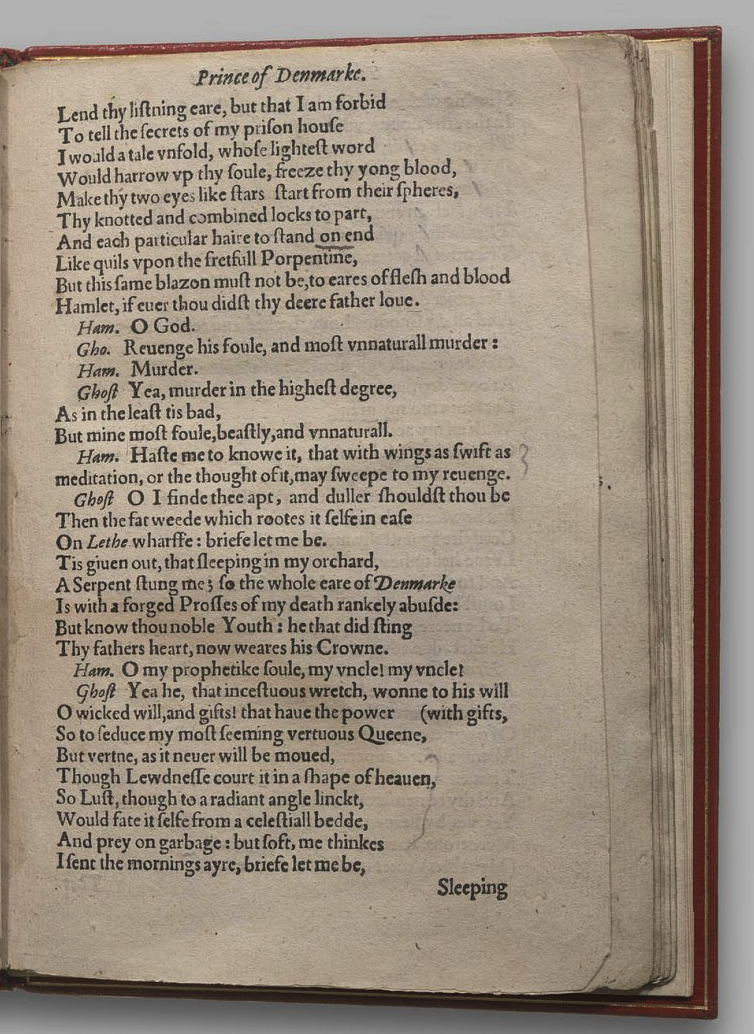
 

Image credit: British Library (Halliwell-Phillips edition). The tragicall historie of Hamlet Prince of Denmarke. First Quarto. London: 1603.

Citing this page:Shakespeare, William. Hamlet, C4r. London: 1603. Cacodemon Digital Shakespeare. Edited by: [Amila J. Shah and Emily Kim]. Source Edition: British Library (Halliwell-Phillips Edition). http://cacodemonshakespeare.com/tragedies/hamlet/c4r.

☜

☞

Notes

  1. "Harrow" means to painfully distress, wound, or tear apart. The Ghost is describing how the mere words of his tale will physically and mentally wound Hamlet, emphasizing the theme that moral corruption is so profound that it manifests as physical pain or destruction.
  2. Warm blood is associated with vitality, so the image of Hamlet's blood freezing indicates corruption disrupting natural life. The corruption in Denmark is so severe that it metaphorically drains warmth from Hamlet's veins, creating a connection between moral destruction and physical decay.
  3. "Porpentine" is an old term for a porcupine. The description of Hamlet's hair standing on end is an instinctive reaction, that reflects the theme of nature responding negatively to moral wrongdoings. The natural world recoils from corruption, and so does Hamlet's body.
  4. The word "foul" points to this idea of decay resulting from moral corruption, and the use of "unnatural" is key to theme of disrupted order. Shakespeare is saying that the murder of a rightful king was a crime against both human and divine law, which upsets the natural balance of the world overall.
  5. The Ghost describes his murder as "beastly," referring to Claudius as an inhuman creature, thus reinforcing the idea that moral corruption degrades individuals and natural order--morally, Claudius is no longer human.
  6. This image is representative of laziness and decay. When a garden is neglected, it begins to physically decay, and in this environment weeds thrive. This connects to corruption's ability to thrive when moral and political structures fail.
  7. Lethe is the river of forgetfulness in Greek mythology. The Ghost is saying that if Hamlet fails to avenge his death, the inaction might be attributed to forgetfulness, which suggests that corruption flourishes, like the previously mentioned weed, when people fail to remember past wrongdoings and seek justice.
  8. The "Serpent" represents Claudius. This biblical imagery serves as a symbol of deception and evil. Claudius' crime is not just a personal betrayal--he is the serpent poisoning Denmark as a whole.
  9. "Rank" suggests rot and disease, continuing the motif of corruption as something that spreads like an infection. Claudius' lies about King Hamlet's death have tainted the entirety of Denmark, thus supporting the idea that misinformation is a form of decay.
  10. The Ghost refers to the marriage between Claudius and Gertrude as incestuous, as a marriage between a widow and her brother and law was considered taboo. This is a violation of the natural order, which mirrors the unlawful nature of his position as king.
  11. The contrast between purity and filth points to a continued theme of decay. It reinforces the idea that corruption leads to not just political ruin, but physical and moral deterioration. Claudius is a scavenging animal, indicating that he himself is degraded by his embrace of corruption. He is a creature who now thrives off of waste, rather than a noble virtuous king.
css.php