Editorial note
This page from Act 5, Scene 1 captures the climax of the ring episode. Nerissa teases Gratiano by suggesting that, since he gave away the ring he had sworn to keep, she too may become “as liberal” as he is. Portia similarly presses Bassanio to explain why he surrendered the ring she had entrusted to him. Antonio, who earlier offered his body as surety in the bond plot, steps in once more to guarantee Bassanio’s faithfulness. The page ends as Portia returns the ring and reveals that she received it from the “doctor” to whom Bassanio had given it. In this way, the page brings together comic misunderstanding, marital testing, and the lingering language of the courtroom bond.
For my transcription, I chose to make respect for the original page my first priority, because I believe that part of what an audience seeks when encountering an early printed text is precisely its historically marked material character. I therefore preserved all of the original page’s textual features, including its spelling conventions, such as "i/j, u/v, and s/l shifts", as well as its italics and spacing, in order to retain as much of the original page’s visual and linguistic essence as possible. At the same time, I wanted the transcription to remain accessible to readers from different backgrounds. For this reason, I added limited clarifications, such as "lince(since)" and rendered parentheses and the explanatory material within them in dark gray.
The text illustrates how the “ring” transforms a seemingly insignificant material object into a test of marital fidelity, trust, and possessive relationships. Words related to exchange and ownership (such as “jewel”), and words related to exchange and ownership (such as “give” and “keep”) are repeatedly interwoven with language of oaths and loyalty (such as “honor”). Thus, the ring is not merely a token of love but also becomes a visible symbol that embodies an intangible promise. Nerissa and Portia subsequently take this logic of exchange a step further, extending it from the ring to the female body itself. Nerissa threatens that she will not refuse the clerk, which effectively implies that if a husband can hand over an object symbolizing marriage to another, then might a wife also hand over her body and intimate relationship to another?
At the same time, the scene complicates that logic because Portia is not simply an object within the exchange. She is the person who secretly controls it. Bassanio appears to make decisions about whether to “give,” “keep,” and “swear”. But Portia has already determined the ring’s circulation disguised as the doctor. She controls who receives it, and when the truth of the exchange is revealed. The ring therefore becomes a symbol of female possession and female agency. It reflects a marital structure in which women may be imagined through the language of property and fidelity, while also showing Portia’s ability to manipulate that same system for her own purposes. By visually distinguishing words connected to objects, promises, and the body, this edition foregrounds how material possession, sexual fidelity, and female agency become entangled in the play’s final scene.
To reflect such logic, I use red to mark words associated with material possession and exchange, blue for oath-making and fidelity, and pink for the body and marital intimacy. Together, these colors visualize the movement from object, to promise, to body, showing how the ring plot connects material exchange with sexual fidelity and female agency.
For my transcription, I chose to make respect for the original page my first priority, because I believe that part of what an audience seeks when encountering an early printed text is precisely its historically marked material character. I therefore preserved all of the original page’s textual features, including its spelling conventions, such as "i/j, u/v, and s/l shifts", as well as its italics and spacing, in order to retain as much of the original page’s visual and linguistic essence as possible. At the same time, I wanted the transcription to remain accessible to readers from different backgrounds. For this reason, I added limited clarifications, such as "lince(since)" and rendered parentheses and the explanatory material within them in dark gray. This allows supplementary information to remain visible without visually competing with or altering the original text, balancing historical fidelity with readability.
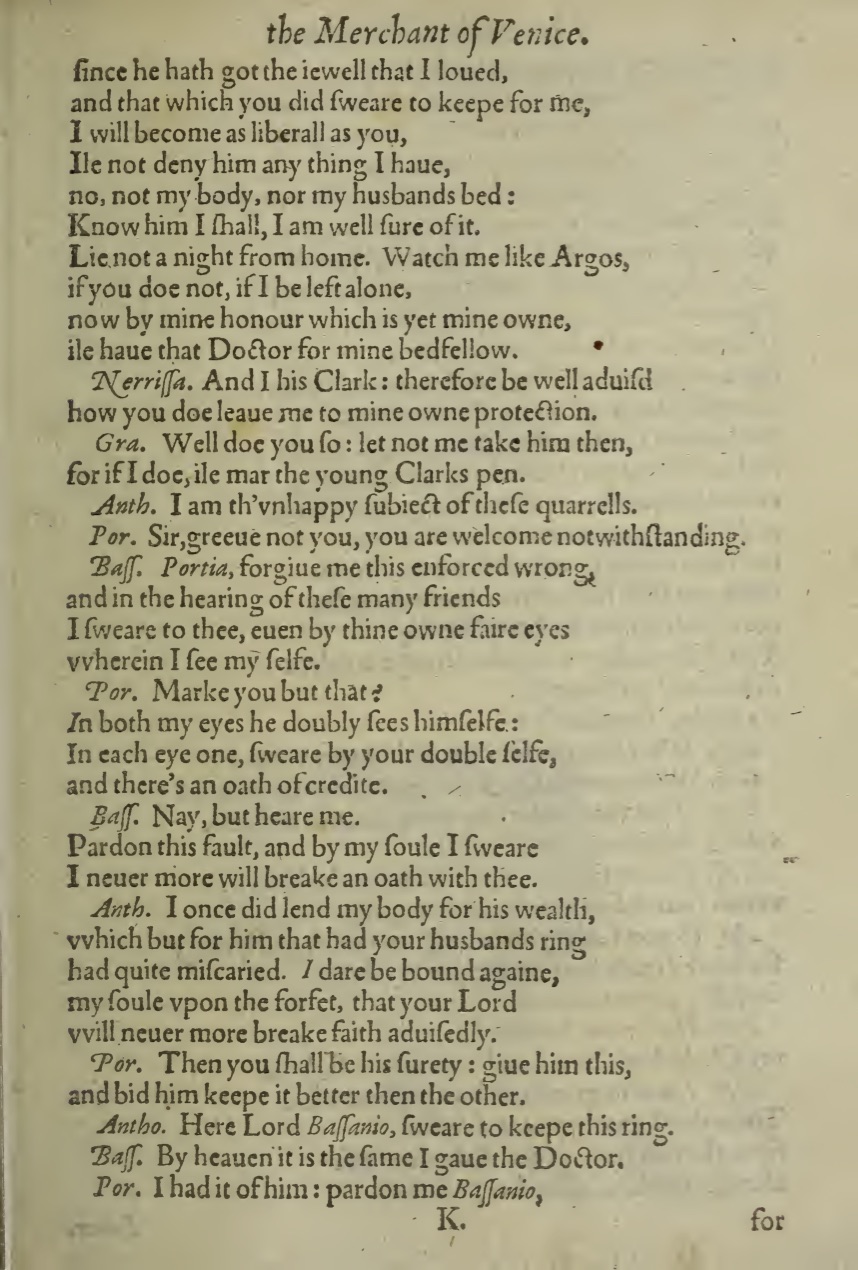
Image credit: Rare Books & Manuscripts Department, Boston Public Library, copy G.176.16. The most excellent historie of the merchant of Venice. First Quarto. London: 1600.
Citing this page: Shakespeare, William. The Merchant of Venice, K1r. London: 1600. Cacodemon Digital Shakespeare. Edited by [your names]. Source edition: Rare Books & Manuscripts Department, Boston Public Library (copy G.176.16). http://cacodemonshakespeare.com/comedies/merchant/k1r.
