Skip to content

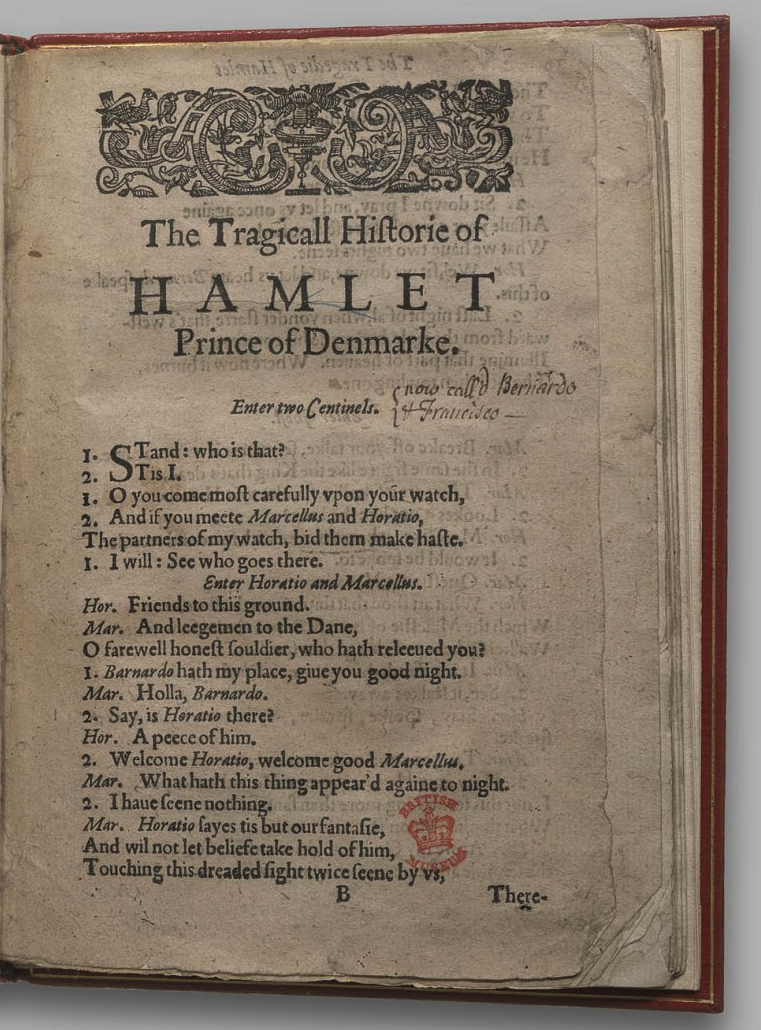
Hamlet, B1r

Editorial Note

We took a very interesting approach to our page. At first, we were tasked with analyzing the page and came to find that, rather than the words, we found that the peripheries of the page caught our attention to the greatest degree. From the footnote to the ornament, there were so many implications that couldn’t have been glossed over. To symbolically represent this, we decided to minimize the text (footnotes still provided) to represent how important these details are. Lastly, the analysis of language along with our fidelity analysis hopefully shows how this document has metaphorically “grown” over time. We think this will encourage undergraduate students who are studying Shakespeare to better grasp what makes these printed editions so unique.

1

The Tragicall Hiſtorie of

H  A  M  L  E  T

Prince of Denmarke.


Enter two Centinels2

1. Stand: who is that?
2.Tis I.
1. O you come moſt carefully vpon your watch,
2. And if you meete Marcellus and Horatio,
The partners of my watch, bid them make haſte.
1. I will: See who goes there.

Enter Horatio and Marcellus.

Hor. Friends3 to this ground.
Mar. And leegemen4 to the Dane,
O farewell honeſt ſouldier, who hath releeued you?
1. Barnardo hath my place, giue you good night.
Mar. Holla5 , Barnardo.
2. Say, is Horatio there?
Hor. A peece of him.
2. Welcome Horatio, welcome good Marcellus.
Mar. What hath this thing appear’d again to night.
2. I haue ſeen nothing.
Mar. Horatio fayes6 tis but our fantaſie,
And will not let beliefe take hold of him,
Touching this dreaded fight twice ſeen by vs,

B

There-

Image credit: British Library (Halliwell-Phillips edition). The tragicall historie of Hamlet Prince of Denmarke. First Quarto. London: 1603.

Citing this page: Shakespeare, William. Hamlet, B1r. London: 1603. Cacodemon Digital Shakespeare. Edited by: Owen Kroeger and Shermaya Paul (Custom Headpiece by Shermaya Paul). Source Edition: British Library (Halliwell-Phillips Edition). http://cacodemonshakespeare.com/tragedies/hamlet/b1r.


☜

☞

Notes

Headpiece Note:

This is a headpiece or a “printers ornament,” a common decorative practice of printers in early 16th—and 17th-century literature. With roots in Greek and Arabesque design and architecture, the headpiece was commonly used by Valentine Simmes, the printer responsible for printing many of Shakespeare’s quartos. The headpiece is a mirror of itself, creating a similar image on both the left and right sides. 

A double “a,” one light (right) and one dark (left) are also featured in the original quarto version — two of the only images not exactly mirroring the other. 

After some intense research, it’s been agreed upon that this ornament contains some ambiguity in its symbolism. The light and dark double “a” might also be hard to notice at first glance, but they symbolize the relationship between life and death that Hamlet questions in his infamous “To be, or not to be” soliloquy. The general imagery of various ivies, fleurons, and birds connects to Ophelia’s descent into madness and eventual death following her obsession with herbs and flowers. It also symbolizes the Garden of Eden in a “Garden of Denmark” way, "Something is rotten in the state of Denmark," (Hamlet, Act 1, Scene 4, Line 90)) as it eventually falls apart and becomes inaccessible due to the temptations of sin. 

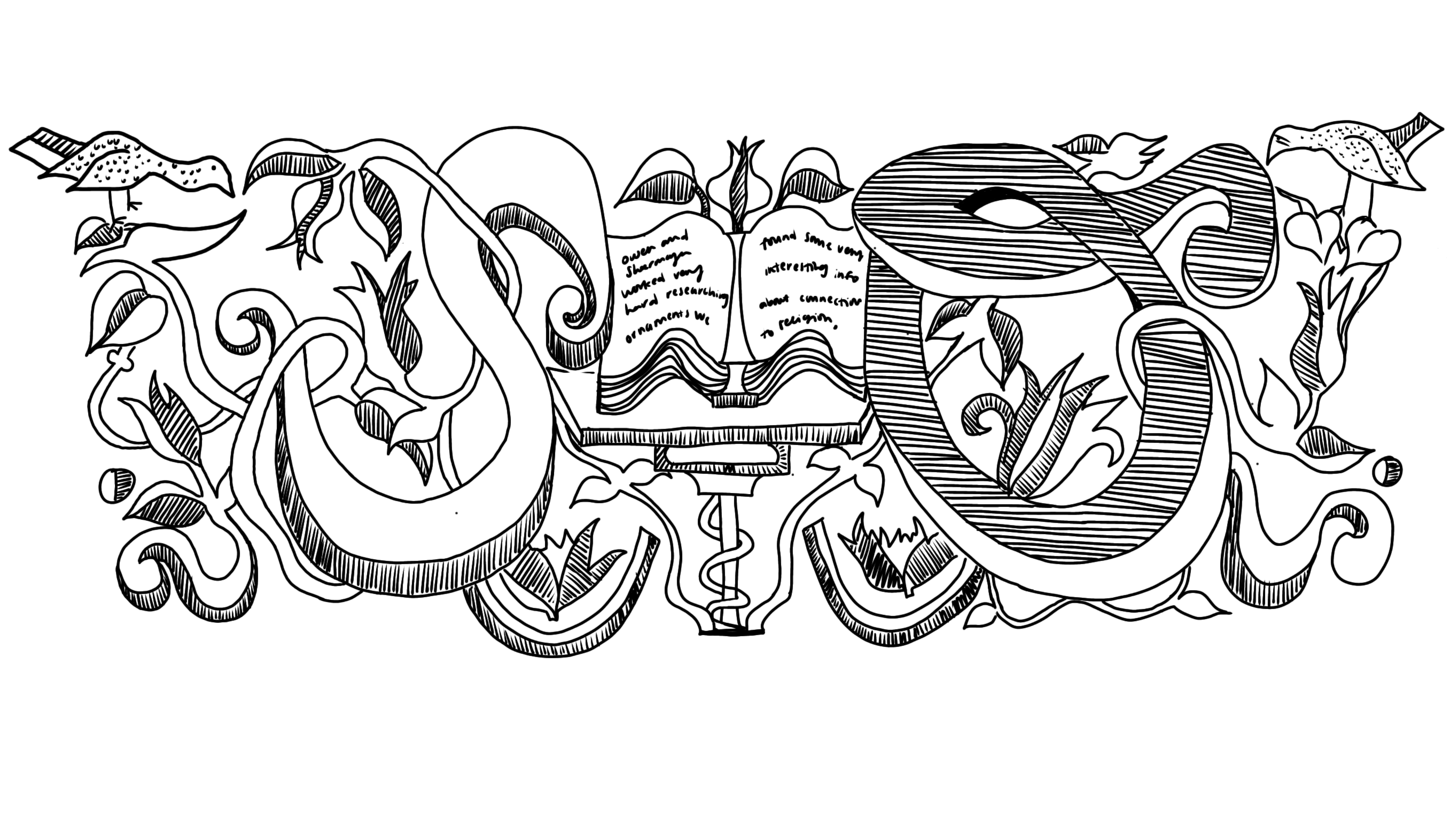
This headpiece is also seen printed on the first quartos of Richard II and Richard III, suggesting a common use when dealing with works themed around divine right, the fragility of power versus influence, the inevitability of decay, and mortality. For our custom headpiece, the initials of the editors are includes, one light and one dark, similar to the original headpiece. 


Works Cited

"English Printers' Ornaments." Internet Archive, https://archive.org/details/b31347873/page/6/mode/2up. Accessed 17 Mar. 2025

"Facsimile Viewer: Richard III, Quarto 1 (1597)." Internet Shakespeare Editions. University of Victoria, https://internetshakespeare.uvic.ca/Library/facsimile/overview/book/Q1_R3.html. Accessed 17 Mar. 2025.

"Friend." Oxford English Dictionary, Oxford University Press, www.oed.com/?tl=true. Accessed 20 Mar. 2025. 

"Richard II (Quarto 1, 1597)." Internet Shakespeare Editions. University of Victoria, https://internetshakespeare.uvic.ca/doc/R2_Q1/index.html. Accessed 17 Mar. 2025.

"The Project Gutenberg eBook of English Printers' Ornaments." Project Gutenberg, https://www.gutenberg.org/files/70528/70528-h/70528-h.htm#Page_51. Accessed 17 Mar. 2025.

“Word Index - Phase I.” University of Michigan Library, quod.lib.umich.edu/cgi/t/text/ww2-idx?page=wwstart%3Bc. Accessed 19 Mar. 2025.


  1. [See Headpiece Note Below]
  2. This version of the text does not include the two sentinels' names, Bernardo and Francisco, and are rather replaced with numbers. In this case, the first quarto utilizes numbers to distinguish them. However, observing the physical page, it can be observed that someone wrote in the character’s new names. This gives insight into the fact that whoever owned this book had awareness of future versions of the text with the names inserted.
  3. According to the Oxford dictionary, the word “friend”, in this case, means a loyalty to the crown. This is a use for the word friend that has fallen out of popularity as we have moved into the modern period.
  4. Within the EEBO–TCP Phase I collection, this spelling of “leegemen” is only seen a total of 6 times while the modern spelling “liegemen” is mentioned 73 times. This shows a gradual move from old English spellings to more modern spellings.
  5. The word “holla” was a popular word used in old english. According to EEBO, the word holla appears a total of 211 times. Its definition/use within this scene is to call attention to something or, in this case, to announce someone’s approach.
  6. This word appearing here is very interesting. The word “faye” was an old English word that meant “fairy”. However, even though they have the same spelling, in this passage the word “fayes” would mean to “fantasize”. This is another instance of how spelling changes and utilization of different words lends way to different definitions contained within a word.
css.php