Footnotes:
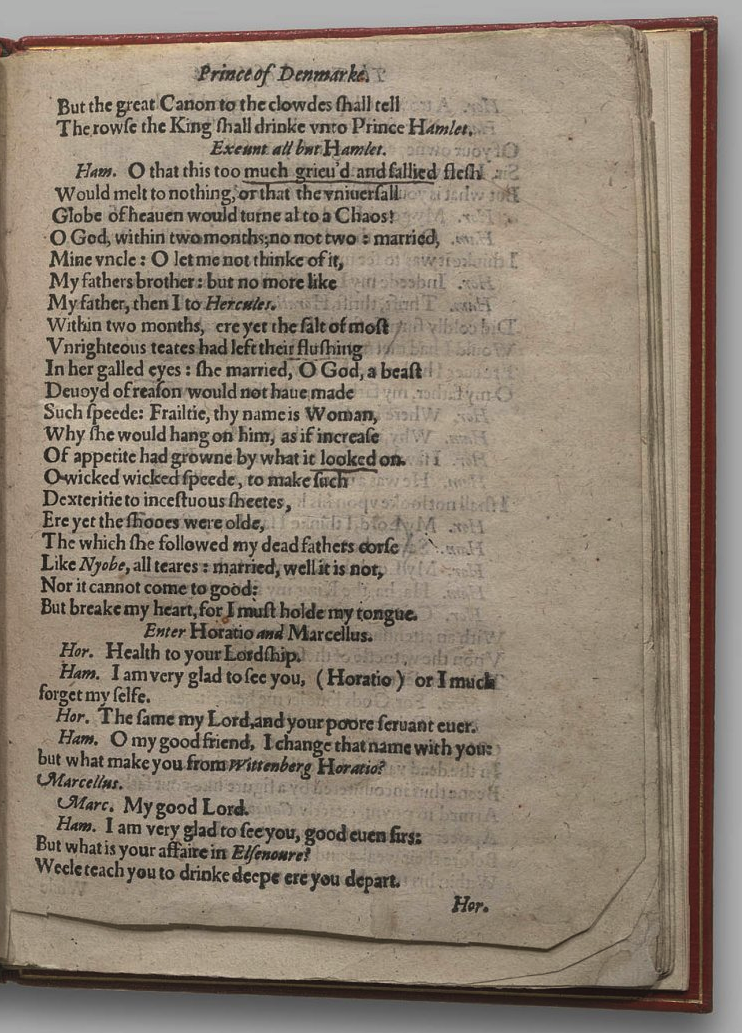
[1] The first two lines of this page conclude the ceremonial/public portion of Scene 1.2, and as such have been transformed into an equally public news release.
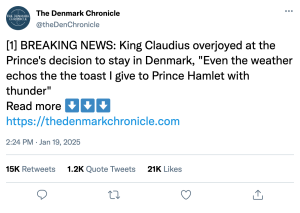
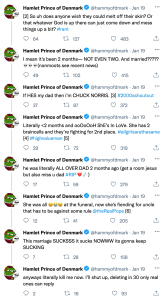
[2] Shakespeare's soliloquies are difficult to grapple with for many reasons, one being the sheer number of thoughts that the character jumps to throughout one monologue, and Hamlet is no different. We chose to show his shifting thoughts through the separation into different twitter "threads" to make the thought process of the character more digestible.
[3] Within the original line, 'no more like / my father, then I to Hercules', Hamlet condemns his uncle through comparison to a temporally antiquated yet commonly invoked hero. As such, this line has been modernized to 'Chuck Norris', as another antiquated yet frequently referred to 'hero' across internet culture.
[4] We chose this hashtag as it demonstrates a bridge between Hamlet's words generalizing women to our society's continued generalized and sexist view of women.
[5] Hamlet's idolization of his father as a strong and overtly masculine character in combination with his condemnation and apparent hatred for the generalized 'women' modernizes into contemporary 'alpha-male/incel' culture. The concept of 'high-value men' is common jargon of this toxically masculine subculture, and as such carries within it the horrific binary perception of gender antagonism revealed in the original text.
[6] In Hamlet's comment of "Incestuous sheets," there is the underlying feeling of disrespect for the religious construct of marriage or 'death do us part', so we included this tagging of the Pope to demonstrate the religious undertones of his argument against Gertrude & Claudius's marriage.
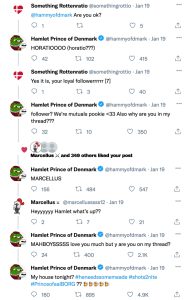
[7] We wanted to play with different ways to demonstrate loyalty and differences in power, so we chose to focus on the Twitter vocabulary of followers, mutuals etc... to evoke how Hamlet maneuvers around the "expected" power dynamics to stay close to Horatio and Marcellus.
