Skip to content

Hamlet, C2v

Editorial note

Shakespeare’s Hamlet is often analyzed through the lens of political power, revenge, and existential crisis, yet one of its most compelling undercurrents is the treatment of female agency, particularly in relation to sexuality and patriarchal control. The passage in question, an exchange between Ophelia and Polonius, reveals a striking moment of female disenfranchisement, as Ophelia is reprimanded and instructed on how to conduct herself in matters of love and desire.

Polonius assumes the role of both father and social enforcer, warning Ophelia that her affections for Hamlet may compromise her reputation and his own honor. His words reflect the broader anxieties of Elizabethan society, where a woman’s virtue was inextricably linked to male authority and her ability to navigate these constraints dictated her social value. Ophelia, in turn, embodies the conflict between obedience and personal agency, her compliance signaling the limited autonomy afforded to women.

Through this annotated guide, we will examine the language, symbolism, and dramatic function of this exchange, exploring how it reflects societal expectations surrounding female sexuality, as well as the consequences of denying women their voices and choices. In doing so, we aim to uncover the power structures that govern Ophelia’s fate and, by extension, the broader treatment of women in Hamlet.

*We have edited the text to more modern spellings for readibility and changed "Corambis" back to "Polonius".

Guide:
Refrences to Ophelia's sexuality
Word of note1

Polonius: 

Thou canst not then be false to any one.

Farewell, my blessing with thee.


Laertes: 

I humbly take my leave. Farewell, Ophelia,

And remember well what I have said to you. [Exit]


Ophelia:

It is already locked within my heart,

And you yourself shall keep the key of it..2


Polonius:

What is’t, Ophelia, he hath said to you?


Ophelia:

Something touching the Prince Hamlet.3


Polonius:

Marry, well thought on. ‘Tis given me to understand

That you have been too prodigal of your maiden presence4

Unto Prince Hamlet. If it be so–

As so ‘tis given to me–and in that way of caution,

I must tell you: you do not understand yourself

So well as befits my honor and your credit.5


Ophelia:

My lord, he hath, made many tenders of his love
to me.6


Polonius:

Tenders, I, I, tenders you may call them.7


Ophelia:

And withall, such earnest vows.8


Polonius:

Springes to catch woodcocks,

What, do not I know when the blood doth burn,

How prodigal the tongue lends the heart vows,

In brief, be more scanter of your maiden preference

Or tendering thus you’ll tender me a fool.9


Ophelia:

I shall obey my lord in all I may.10


Polonius: 

Ophelia, receive none of his letters,

“ For lovers lines are snares to intrap the heart;

“ Refuse his tokens, both of them are keys

To unlock Chastity unto Desire;11

Come in Ophelia, such men often prove,

“ Great in their words, but little in their love.12


Ophelia:
I will my lord.13 [exeunt]


[Enter Hamlet, Horatio, and Marcellus]


Hamlet: 

The air bites shrewd; it is an eager and
A nipping wind, what hour is it?


Horatio:

 I think it lacks of twelve,   [Sound Trumpets.]


Marcellus:  

No, tis struck,
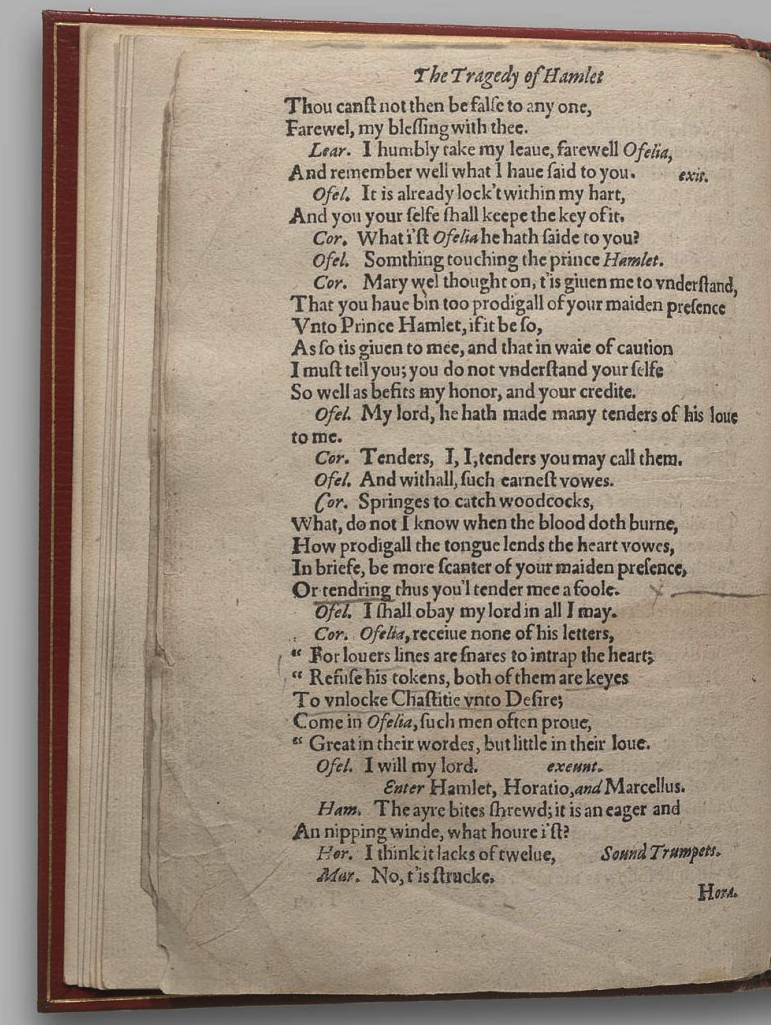
Image credit: British Library (Halliwell-Phillips edition). The tragicall historie of Hamlet Prince of Denmarke. First Quarto. London: 1603.

Citing this page: Shakespeare, William. Hamlet, C2v. London: 1603. Cacodemon Digital Shakespeare. Edited by: Caden Garza & Rebecca Golts. Source Edition: British Library (Halliwell-Phillips Edition). http://cacodemonshakespeare.com/tragedies/hamlet/c2v.

☜

☞

Notes

  1. Notice how the word "tenders" is used. It shifts meaning through out this scene and transformed by Polonius.
  2. A very intimate portion of her being is accessed and in the hands of her father and brother. Women lacked independence and the right to make choices. 
  3. Could be interpreted sexually and show Ophelia's desire for Hamlet. 
  4. Polonius is calling Ophelia "easy" here, she's too good at being a woman, insinuating that she is throwing herself at Hamlet and being reckless with her maidenhood.
  5. He is stating here that he understands her, the prince, their relationship, and the events. surrounding them far better than she does. This shows an assumed female intelligence inferiority
  6. Hamlet, according to Ophelia, is approaching her with a gentleness. Either he is truly acting this way or this is showing Ophelia's desire to have Hamlet love her.
  7. He is implying that he sees Hamlet's actions for what they are, despite not having been present when they occurred. He implies that Ophelia is not able to discern Hamlet's true character, belittling her and their relationship in the process.
  8. Ophelia is referencing Hamlet's pursuit of her, but the usage of "vows" is interesting especially in relation to the idea of marriage. Vows are supposed to be sacred, such as "death do us part", but is Hamlet's love really sacred? 
  9. He only cares about his own image not the emotions his daughter is feeling. He does not care to lighten the blow of his insinuations either, proving on an extreme level how he disregards her feelings. 
  10. Without any protest from Ophelia she submits to her fathers desires, is this what makes her the perfect daughter? 
  11. Oddly reminiscent of what Ophelia says previously to Laertes. Polonius is implying that as her father and as Laertes is her brother they have rights to her chastity and desire.
  12. Applying the characteristic to men that they aren't lovers, but rather only after a woman's "Chastity".
  13. Ophelia is completely subservient to her father and holds no autonomy in her own life. She is extremely passive in this scene. 
css.php